
If your home still has an old fuse panel, you may be wondering whether it is time to upgrade. From a home inspection perspective, the answer should depend on the condition of the equipment and the home's needs—not simply on whether the panel uses fuses or breakers. A properly planned replacement can improve convenience and address problems with aging equipment, but it is not a cure-all for every electrical issue.
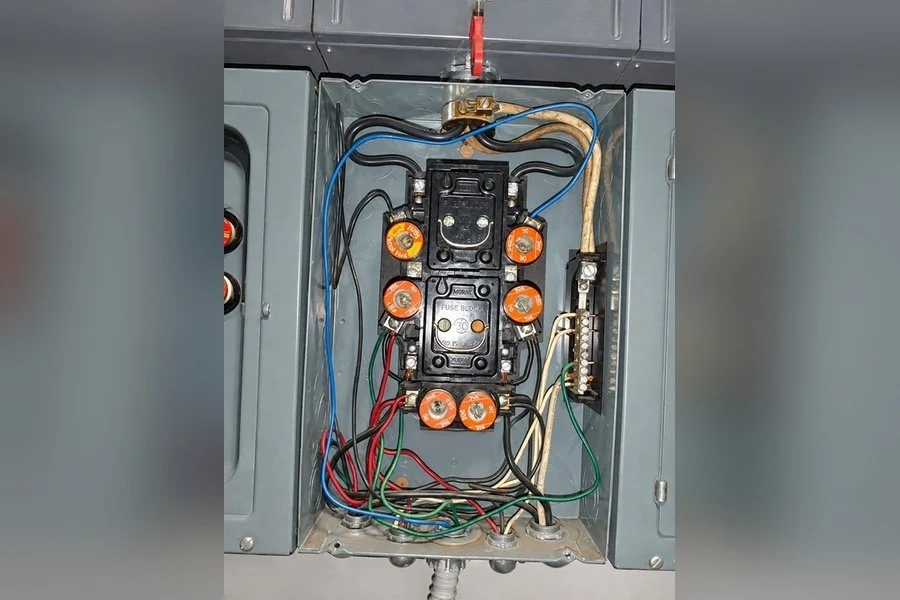
Vintage fuse panel
Fuses vs. Breakers: What Is the Difference?
Fuses and breakers both protect against excessive current. A fuse opens the circuit when its internal element melts; once it operates, it must be replaced with the correct type and rating. A breaker trips to interrupt the circuit and can generally be reset after the cause has been identified and corrected.
The important distinction is not that all fuses are unsafe and all breakers are safe. Correct sizing, equipment condition, proper installation, and compatible wiring matter with either system.
Considerations for Upgrading an Old Fuse Panel?
Address aging equipment -
An older panel may have deteriorated components, corrosion, damaged connections, or signs of overheating. Replacing compromised equipment can be a strong reason to upgrade. However, installing breakers alone does not correct unsafe wiring elsewhere in the house. A qualified electrician should evaluate the entire scope of the problem.
Make circuit protection easier to manage—
breakers eliminate the need to keep replacement fuses on hand. They also reduce the risk of someone installing an incorrectly rated replacement fuse. That convenience does not make repeated tripping harmless: a breaker that keeps tripping—or a fuse that keeps blowing—is a reason to investigate, not to install a larger device.
Plan for the home’s electrical needs –
There is a real good chance that there is a lot more electrical demand today than when your home was built. I think back to when I was a kid. We had a stove, oven, refrigerator/freezer, toaster, and a coffee pot in the kitchen. Washer and dryer in the utility room, a TV and a stereo in the living room, as well as lighting in each room. Compare that with what most homes have today.
If you are adding appliances, remodeling, or planning new electrical equipment, it is a good time to evaluate circuit space and service capacity. A new breaker panel does not automatically increase the power available to your home. The electrician should determine whether a panel replacement, additional circuits, or a service upgrade is needed.
Discuss updated protective options - A replacement project is also an opportunity to discuss ground-fault and arc-fault protection with your electrician. The appropriate equipment and requirements depend on the installation and local codes. Ordinary breakers are not a substitute for all types of electrical protection.
What Does a Home Inspection Tell You?
At HomePro Inspections, we can identify visible concerns and recommend further evaluation. An old fuse panel warrants attention, but its presence alone does not prove the entire electrical system is unsafe. The panel's condition, signs of improper modifications, and the limits of what can be inspected all matter.
Ask your inspector to explain the findings, then have a qualified electrician assess the recommended repairs and replacement options. A home inspection is not a substitute for an electrical load calculation or a detailed upgrade design.
Summary
Upgrading an old fuse panel to breakers can simplify maintenance and provide an opportunity to address aging equipment and your home's evolving electrical needs. The best reason to upgrade is a documented need—not the assumption that fuses are always bad or that breakers solve everything.
At HomePro Inspections, we are trained to identify these issues during home inspections. We document any problems and recommend resolution by a qualified professional.
Visit our website to learn more or to schedule your home inspection in the Rochester, Owatonna, and Faribault, MN areas. You can contact us today at (507) 202-8942, email us, or use our online “Schedule Now” feature to schedule an appointment.